


Accidents Involving Farm Vehicles: A Unique Hazard on Cumberland County Roads
Request a Free ConsultationVineland and surrounding Cumberland County roads frequently carry tractors, combines, and farm trucks that move between fields on public highways. These slow-moving vehicles create collision risks that drivers often do not anticipate, especially on roads where traffic normally moves at 45 or 55 miles per hour.
Many people who collide with farm equipment assume these crashes fall outside normal injury claims. That assumption is incorrect. Farm vehicles operating on public roads must follow applicable traffic laws, maintain proper markings when required, and use appropriate lighting based on conditions. When operators fail to meet these requirements and crashes result, injured drivers may pursue compensation just as they might after any other vehicle collision.
Key Takeaways for Farm Vehicle Accident Claims in New Jersey
- Farm vehicles designed to operate at 25 miles per hour or less must display slow-moving vehicle emblems under N.J.S.A. 39:3-24.2, with applicability depending on vehicle design and use, and failure to comply may support negligence claims.
- New Jersey’s modified comparative fault rule under N.J.S.A. 2A:15-5.1 allows recovery as long as your fault does not exceed 50 percent, with damages reduced by your share of responsibility.
- Commercial farms often carry liability insurance that covers equipment operators, making these claims more similar to commercial vehicle cases than personal auto accidents.
- Rear-end collisions with slow-moving farm equipment frequently involve questions about whether the vehicle displayed adequate warnings and whether the following driver had sufficient opportunity to react.
- The two-year statute of limitations under N.J.S.A. 2A:14-2 applies to farm vehicle accident claims in New Jersey, creating a deadline for filing personal injury lawsuits.
Why Farm Vehicle Crashes Happen on Cumberland County Roads
Cumberland County’s agricultural character means farm equipment regularly shares roads with passenger vehicles. Tractors pulling equipment between fields, farm trucks hauling produce, and combines traveling to work sites all use public highways that were designed primarily for faster-moving traffic.
The speed differential creates the core danger. A tractor traveling 15 miles per hour on a road where traffic moves at 50 miles per hour closes the gap quickly for approaching vehicles.
The Speed Differential Problem
When a vehicle traveling 50 miles per hour approaches a tractor moving at 15 miles per hour, the closing speed is 35 miles per hour. A driver who does not immediately recognize the farm vehicle as slow-moving has limited time to react. On roads with curves, hills, or limited sight distances, this reaction time shrinks further.
Dusk and early morning hours present particular risks. Farm operations often begin before sunrise and continue after sunset. Inadequate lighting on farm equipment makes these vehicles difficult to see during low-light conditions when many agricultural vehicles are on the road.
Common Crash Scenarios in Vineland and Surrounding Areas
Farm vehicle crashes in Cumberland County follow recognizable patterns. The circumstances that lead to these collisions often reveal whether the farm vehicle operator, the other driver, or both contributed to the crash.
Crash types that commonly involve farm equipment include:
- Rear-end collisions when drivers encounter slow-moving vehicles unexpectedly
- Sideswipe crashes when drivers attempt to pass farm equipment on narrow roads
- Head-on collisions when passing vehicles misjudge oncoming traffic
- Intersection crashes when farm vehicles turn without adequate signals
- Run-off-road crashes when drivers swerve to avoid farm equipment
Each scenario raises different questions about which party bore responsibility and whether proper precautions were in place.
New Jersey Laws That Govern Farm Vehicles on Public Roads
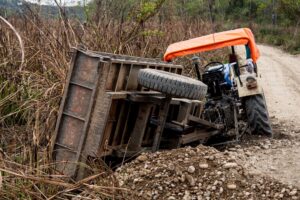 New Jersey law permits agricultural vehicles on public highways but imposes requirements that are designed to protect other motorists. Farm vehicle operators who fail to meet applicable requirements may face liability when crashes occur.
These laws establish baseline safety standards, though specific obligations depend on vehicle type, design speed, and operating conditions.
Slow-Moving Vehicle Emblem Requirements
N.J.S.A. 39:3-24.2 requires vehicles designed to travel at 25 miles per hour or less to display a slow-moving vehicle (SMV) emblem. This fluorescent orange triangle with a reflective border alerts approaching drivers that the vehicle ahead moves significantly slower than normal traffic. Applicability depends on whether the specific vehicle meets the statutory definition based on its design and intended use.
The emblem must be mounted on the rear of the vehicle, centered and visible from a distance. Faded, damaged, or improperly positioned emblems may fail to provide adequate warning. Missing emblems leave approaching drivers with no indication that the vehicle ahead is slow-moving.
Lighting and Reflector Standards
Under New Jersey traffic regulations, farm vehicles operating during darkness or limited visibility must meet applicable lighting and reflector requirements based on vehicle type and conditions. These obligations vary depending on the equipment’s classification and the specific circumstances of operation.
Many farm vehicle crashes occur because equipment lacked required lighting or displayed lights that were too dim, dirty, or improperly positioned. A tractor with a single dim taillight on a dark road presents a very different hazard than one with proper illumination and reflective markings.
Width and Overhang Considerations
Farm equipment often exceeds normal vehicle width. Implements being towed may extend beyond the tractor’s profile. New Jersey law addresses these situations through oversize load and permit rules, which may require additional markings or escort vehicles depending on the equipment’s dimensions.
Equipment that extends into adjacent lanes without proper marking creates collision risks for passing vehicles and oncoming traffic. When width contributes to a crash, the operator’s compliance with applicable marking requirements becomes relevant to liability.
How Liability Works in Farm Vehicle Crashes
Farm vehicle crashes are not exempt from normal negligence principles. The agricultural purpose of the trip does not shield operators from responsibility when their conduct causes injuries. These claims analyze fault the same way other vehicle accident claims do.
The key questions involve what each party knew, what they did, and whether their actions were reasonable under the circumstances.
When the Farm Vehicle Operator Bears Responsibility
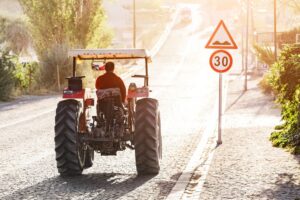 Farm vehicle operators may be negligent when they fail to follow applicable safety requirements or operate carelessly on public roads. Missing or inadequate markings, improper lighting, failure to yield when appropriate, and operating equipment that is not roadworthy all may support liability.
Factors that may indicate farm operator negligence include:
- Missing or damaged slow-moving vehicle emblems on vehicles required to display them
- Inadequate lighting during darkness or low-visibility conditions
- Failure to signal turns or lane changes
- Blocking roadways without warning or flaggers
- Operating equipment with mechanical defects
When evidence establishes these failures, the farm vehicle operator or their employer may bear responsibility for resulting injuries.
When the Approaching Driver Shares Fault
Drivers approaching farm equipment also have duties. They must maintain a lookout, drive at speeds that allow them to stop within visible distances, and pass only when safe. A driver who was speeding, distracted, or attempted an unsafe pass may share responsibility for the crash.
Under New Jersey’s modified comparative fault statute (N.J.S.A. 2A:15-5.1), shared responsibility reduces but does not necessarily eliminate recovery. If the farm vehicle operator was 70 percent responsible and the approaching driver 30 percent responsible, the approaching driver’s recovery decreases by 30 percent.
Commercial Farm Insurance and Why It Matters
Many farm vehicle crashes involve commercial agricultural operations rather than individual farmers. Commercial farms typically carry liability insurance that covers their equipment and employees. This insurance often provides coverage limits that exceed typical personal auto policies.
This distinction matters because it affects the resources available to compensate injured people.
Farm Vehicles as Commercial Equipment
A tractor operated by a farm employee traveling between work sites functions similarly to a commercial truck traveling between job sites. The farm benefits economically from the equipment’s use on public roads. This commercial character supports arguments that the farm bears responsibility for safe operation.
Commercial farm insurance policies typically cover liability arising from farm vehicle operations. These policies may provide substantial coverage limits, particularly for larger agricultural operations. Identifying the correct insurance coverage often requires an investigation into the farm’s business structure and policies.
Multiple Potentially Liable Parties
Farm vehicle crashes may involve several parties who bear potential responsibility. The equipment operator, the farm owner, the farm’s corporate entity, and sometimes equipment maintenance providers all may face claims depending on what caused the crash.
Identifying all potentially responsible parties helps accident victims fight for fair compensation when their injuries are serious. A claim against only the individual operator may access limited resources, while claims against the farm business may reach commercial insurance coverage.
Evidence That Strengthens Farm Vehicle Accident Claims
 Farm vehicle crashes require evidence that documents both the collision and the conditions that contributed to it. Physical evidence, photographs, and documentation all help establish what happened and why.
Gathering this evidence promptly matters because conditions change and memories fade.
Documenting Vehicle Markings and Lighting
Photographs of the farm vehicle’s markings, lighting, and reflectors taken shortly after the crash preserve critical evidence. A missing SMV emblem or non-functioning lights may be repaired or the vehicle may be moved before anyone documents its condition.
Evidence related to the farm vehicle’s safety equipment includes:
- Photographs showing the presence or absence of SMV emblem
- Images documenting the condition of lights and reflectors
- Measurements of emblem placement and visibility
- Records of any equipment modifications or repairs
- Maintenance logs showing the lighting system’s condition
This documentation helps to establish whether the farm vehicle met applicable legal requirements at the time of the crash.
Witness Accounts and Scene Evidence
Other drivers who witnessed the crash or observed the farm vehicle before the collision may provide valuable testimony. They may have noticed the vehicle was difficult to see, was blocking traffic, or was operating erratically.
Police reports, photographs of the scene, and any available surveillance footage also contribute to establishing what happened. Skid marks, debris patterns, and vehicle positions help reconstruct the collision sequence.
FAQ for Farm Vehicle Accident Claims
Are farm vehicles required to use public roads, or are there alternatives?
Farm vehicles use public roads because fields are often separated by highways and there are no practical alternatives. New Jersey law permits this use but requires applicable safety precautions. The necessity of road use does not excuse failures to follow safety requirements.
What if the farm vehicle was being operated by a teenage family member?
Liability may extend to the farm owner when the operator was acting with permission or under the owner’s control, including situations involving negligent entrustment or supervision. The operator’s age, experience, and training become relevant factors in determining whether the owner exercised reasonable care in allowing equipment operation.
Do agricultural exemptions affect injury claims?
Agricultural exemptions in New Jersey law primarily address vehicle registration and certain equipment requirements, not liability for injuries. These exemptions do not shield farm operators from negligence claims when their conduct causes crashes. Injured parties may still pursue compensation regardless of registration exemptions.
What happens if the farm vehicle was being towed and the connection failed?
Equipment that separates from a towing vehicle and causes a crash raises questions about maintenance, inspection, and proper connection. The farm operator has a duty to verify that towed equipment is properly secured. Failure to do so may support negligence claims against the operator and potentially the farm.
How do weather and road conditions affect these claims?
Poor visibility from fog, rain, or darkness increases the importance of proper markings and lighting. Farm operators who take equipment onto roads during low-visibility conditions without adequate lighting may face stronger negligence arguments. Weather conditions also affect the following drivers’ duties to adjust speed and maintain lookout.
When Rural Roads Become the Scene of Serious Injuries

Richard Grungo Jr., Esq., Personal Injury Lawyer
Cumberland County’s agricultural heritage means farm vehicles on public roads are part of daily life. For drivers who collide with slow-moving equipment, the experience is anything but routine. Serious injuries result from impacts with heavy agricultural machinery, and the aftermath involves questions that typical car crash resources do not address.
Personal injury lawyers at Grungo Law represent injured drivers throughout Vineland and Cumberland County who need help sorting out complex farm vehicle accident claims. Our team investigates whether proper markings and lighting were in place, identifies all potentially responsible parties, and works to fight for fair compensation when negligence caused the crash.
If a collision with a tractor, farm truck, or other agricultural equipment left you injured on a Cumberland County road, contact Grungo Law for a free consultation. We handle these claims on a contingency basis, which means you owe no attorney fees unless we recover compensation for you.