


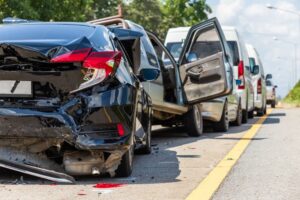
Chain-reaction crashes on I-76 often leave multiple drivers pointing fingers at each other while insurance companies search for ways to minimize their exposure. When five or six vehicles collide in rapid succession, determining who caused the pileup requires reconstructing events that unfolded in seconds.
The Schuylkill’s design makes these crashes particularly common. Some stretches have tight lanes and limited shoulder space compared to many newer highways. Constant stop-and-go traffic creates conditions where one moment of inattention triggers a cascade of impacts. Drivers caught in the middle of a pileup often have no idea what happened ahead of them before they felt the first impact. Sorting out fault in these situations takes investigation, not assumptions; a skilled car accident lawyer can help determine liability.
Key Takeaways for I-76 Chain-Reaction Crash Claims
- Chain-reaction crashes often trace back to an initial trigger, which may involve negligence, a roadway hazard, or another event, and identifying that trigger requires analysis of impact sequence, damage patterns, and witness accounts.
- Not every rear-end driver automatically bears fault, as sudden stops, debris in the roadway, or inadequate reaction time may shift responsibility to other parties.
- Pennsylvania’s comparative fault rule under 42 Pa.C.S. § 7102 allows recovery when your fault does not exceed 50 percent, with damages reduced by your share of responsibility.
- Event Data Recorders (EDRs) and dashcam footage may provide objective evidence of speed, braking, and timing that witness accounts alone cannot establish.
- The two-year statute of limitations under 42 Pa.C.S. § 5524 applies to Pennsylvania car accident claims, creating a deadline for filing personal injury lawsuits.
For a free legal consultation, call (856) 528-4494
Why the Schuylkill Creates So Many Multi-Vehicle Crashes
Many Philadelphia commuters associate I-76 with heavy congestion and abrupt slowdowns. Crashes occur frequently along I-76 in Philadelphia, reflecting the corridor’s challenging conditions. The roadway’s physical characteristics contribute directly to chain-reaction collision risk.
Tight Lanes and Limited Shoulders
Some sections of the Schuylkill have lane widths and shoulder space that feel cramped compared to many newer highways. Vehicles travel closer together laterally than on wider roadways. When crashes occur, drivers have limited room to steer around sudden obstacles. A vehicle that stops abruptly leaves following drivers with few options besides braking hard and hoping the drivers behind them react in time.
The minimal shoulders mean disabled vehicles often remain partially in travel lanes. This creates secondary hazards that trigger additional collisions as traffic approaches the initial crash scene.
Stop-and-Go Traffic Patterns
Rush hour on I-76 involves constant speed changes. Traffic moves at highway speeds, then slows to a crawl, then accelerates again. These transitions happen repeatedly throughout a commute. Each slowdown creates rear-end collision risk for drivers who do not adjust their following distance.
The unpredictability of these slowdowns matters legally. A driver following at a safe distance for 55 mph traffic may suddenly face stopped vehicles around a curve. Whether that driver had adequate time and space to stop affects fault analysis.
How Investigators Determine Who Started the Pileup
Chain-reaction crashes involve multiple impacts that occur within seconds. Police officers arriving afterward see vehicles scattered across lanes with damage on multiple sides. Witness statements often conflict because each driver experienced a different portion of the collision sequence. Determining who caused the initial impact requires working backward from the final positions.
Impact Sequence Analysis
The order of collisions matters more than the number of vehicles involved. A five-car pileup may have begun when the first driver rear-ended the second, pushing that vehicle into the third. Alternatively, the first driver may have stopped safely while the third driver rear-ended the second, creating a forward chain reaction.
Factors that help establish impact sequence include:
- Damage patterns showing direction and force of each impact
- Final vehicle positions relative to travel lanes
- Statements from drivers and passengers about what they felt and when
- Accounts from witnesses who observed the crash from outside the pileup
- Electronic data showing braking and speed changes
Each piece of evidence contributes to reconstructing the sequence. No single factor determines fault alone.
Damage Pattern Interpretation
Vehicle damage tells a story about how collisions occurred. Front-end damage indicates striking another vehicle. Rear-end damage indicates being struck. Vehicles in the middle of pileups often show both, but the relative severity and angles of damage provide information about force and direction.
Crush depth relates to speed at impact. A vehicle with severe front-end damage likely struck the vehicle ahead at higher speed than one with minor bumper damage. These differences help establish which impacts involved the most force and which drivers may have been traveling fastest.
Click to contact our personal injury lawyers today
Why Rear-End Drivers Are Not Always at Fault
Pennsylvania law requires drivers to maintain a following distance that allows them to stop safely. This duty leads many people to assume that any rear-end collision is automatically the following driver’s fault. Chain-reaction crashes complicate this assumption significantly. The legal analysis considers what each driver knew and how much time they had to react.
Sudden Stops and Unexpected Hazards
A driver who stops abruptly for no apparent reason may share responsibility for a rear-end collision. Brake-checking, stopping in a travel lane to read directions, or reacting to distractions inside the vehicle all create hazards that following drivers may not anticipate.
Similarly, debris in the roadway, animals, or pedestrians may cause sudden stops that following drivers had no reason to expect. The reasonableness of the stop and the following driver’s opportunity to react both factor into fault analysis.
The Pushed-Into Defense
Drivers in the middle of chain-reaction crashes often assert they were pushed into the vehicle ahead by the impact from behind. This “pushed-into” defense argues that the rear impact caused the front collision, making the following driver’s negligence the true cause.
Evidence that supports or undermines this defense includes:
- Whether the middle vehicle had already stopped before the rear impact
- Gap distance between vehicles before any collision occurred
- Timing of front and rear damage based on crush patterns
- EDR data showing whether brakes were applied before front impact
This defense does not automatically succeed. Courts evaluate the specific evidence to determine whether the pushed-into theory fits the physical facts.
Complete a Free Case Evaluation form now
Evidence That Helps Establish Responsibility
 Chain-reaction crash claims depend heavily on evidence gathered shortly after the collision. Physical evidence, electronic data, and witness accounts all contribute to understanding what happened. The quality and availability of this evidence often determines how clearly fault may be established. Acting to preserve evidence quickly strengthens claims.
Event Data Recorder Information
Modern vehicles may contain Event Data Recorders (EDRs), sometimes called vehicle “black boxes,” that capture data about speed, braking, and other parameters in the seconds before and during a crash. Many vehicles record this information, though data availability varies by manufacturer and model year.
EDR data from multiple vehicles in a pileup may help establish the sequence of events. A vehicle whose EDR shows hard braking five seconds before impact tells a different story than one showing no braking until the moment of collision. This objective data helps resolve conflicting driver accounts.
Dashcam and Traffic Camera Footage
Dashcam footage from any vehicle in or near the pileup may capture critical moments. Forward-facing cameras show what the driver saw. Rear-facing cameras may show following vehicles approaching too quickly. Even footage from uninvolved vehicles passing the scene may provide a useful perspective.
Traffic cameras operated by PennDOT monitor portions of I-76. This footage may be available for crashes that occur within camera coverage areas. Preservation requests must go to the appropriate agency promptly, as footage retention periods vary.
Independent Witness Accounts
Witnesses who observed the crash from outside the pileup often provide the clearest accounts. A driver in an adjacent lane or a passenger in a vehicle that avoided the collision may have seen the initial impact that drivers within the pileup missed.
Identifying these witnesses presents challenges. They often leave the scene after providing information to police or after determining they were not involved. Police reports sometimes include witness contact information, though not all witnesses stop or provide statements.
How Insurance Companies Approach Multi-Vehicle Claims
Insurance companies representing different drivers in a pileup each conduct their own investigations. Their conclusions often conflict because each insurer looks for ways to minimize their insured’s responsibility. This creates situations where injured drivers face multiple companies pointing fingers at each other. Navigating these competing positions requires understanding how insurers operate.
Disputes Among Multiple Insurers
Each insurance company wants to attribute fault to drivers insured by other companies. A five-car pileup may produce five different liability theories, each placing primary blame on someone other than that insurer’s policyholder. Injured drivers caught in this situation may find their claims delayed while insurers investigate and negotiate among themselves.
This dynamic does not mean fault cannot be established. It means that injured drivers may need independent investigation and analysis rather than relying on any single insurer’s conclusions.
Comparative Fault Allocation
Under 42 Pa.C.S. § 7102, Pennsylvania uses a modified comparative fault system. Multiple drivers may share responsibility for a crash, with each bearing a percentage of fault. An injured driver recovers as long as their own fault does not exceed 50 percent, with damages reduced by their share of responsibility.
Here is one hypothetical example of how fault percentages might be allocated when evidence supports it: Driver A bears 60 percent for the initial rear-end collision, Driver B bears 25 percent for following too closely, and Driver C bears 15 percent for delayed braking. In this case, Driver A cannot recover compensation, while Driver B and Driver C’s compensation will be reduced by their percentage of fault. Each actual allocation depends on evidence supporting the specific percentages in that case.
The Role of Accident Reconstruction
Complex chain-reaction crashes benefit from professional accident reconstruction analysis. These professionals apply physics and engineering principles to physical evidence, creating detailed accounts of how collisions occurred.
Courts may accept reconstruction analysis when it meets evidentiary standards and uses reliable methods.
What Reconstruction Analyzes
Reconstruction professionals examine physical evidence, vehicle specifications, roadway conditions, and electronic data. They apply established formulas to calculate speeds, determine impact sequences, and identify points of collision within the roadway.
Analysis typically addresses:
- Speed of each vehicle before, during, and after impacts
- Sequence and timing of collisions within the pileup
- Whether specific drivers had time and distance to stop
- How damage patterns correlate with reported collision sequence
- Point of impact locations within travel lanes
This analysis provides technical support for fault arguments that witness testimony alone may not establish.
Limitations of Reconstruction Evidence
Reconstruction provides analysis, not certainty. Professionals develop opinions based on available evidence, and those opinions may be challenged. Courts evaluate reconstruction testimony alongside other evidence, and factfinders ultimately decide what weight to give it.
When physical evidence is limited or ambiguous, reconstruction analysis becomes less definitive. The method works best when substantial physical evidence, electronic data, and witness accounts provide multiple data points for analysis.
FAQ for Schuylkill Expressway Chain-Reaction Claims
What if the police report assigns fault incorrectly?
Police reports reflect the officer’s initial assessment, not binding legal conclusions. Officers often arrive after vehicles have moved and rely on driver statements that may be self-serving. Independent investigation may reveal evidence that contradicts the police report’s fault assignment.
What if one of the drivers in the pileup was uninsured?
Uninsured drivers complicate recovery but do not eliminate it. Your own uninsured motorist coverage may apply. Other at-fault drivers with insurance may bear responsibility for your damages. The allocation of fault determines which sources of recovery are available.
Does it matter which lane I was in when the pileup occurred?
Lane position may affect fault analysis depending on the circumstances. A driver changing lanes immediately before the crash faces different questions than one traveling steadily in the same lane. Evidence of lane changes, merging, or cutting off other vehicles all factor into the analysis.
What if I was injured but my car shows little visible damage?
Injury claims do not require major vehicle damage, but insurers might question causation when visible damage is minimal. Medical records and other evidence become especially important in these situations to establish the connection between the crash and your injuries.
When Seconds on I-76 Turn Into Months of Recovery

Richard Grungo Jr., Esq., Personal Injury Lawyer
A chain-reaction crash on the Schuylkill unfolds in moments but leaves injured drivers facing months or years of medical treatment and uncertainty. The number of vehicles and insurers often leads to longer investigations and more disputes about responsibility. Injured drivers caught in these disputes benefit from having someone who understands how to navigate the complexity.
Personal injury lawyers at Grungo Law represent injured drivers throughout Philadelphia who need help sorting out responsibility in multi-vehicle I-76 crashes. Our team works to gather evidence, analyze collision sequences, and fight for fair compensation when another driver’s negligence triggered the pileup.
If a chain-reaction crash on the Schuylkill Expressway left you injured and uncertain about your options, contact Grungo Law for a free consultation. We handle these claims on a contingency basis, which means you owe no attorney fees unless we recover compensation for you.
Call or text (856) 528-4494 or complete a Free Case Evaluation form